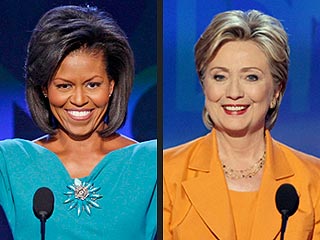
 “Yes we can” almost wasn’t: According to a new book, President Obama didn’t originally like his campaign slogan when David Axelrod introduced it during his Senate race in 2004 and almost nixed it, until Michelle intervened. “Trust me,” she said, “It will work.” Barack and Michelle: Portrait of an American Marriage also alleges that Michelle was a crucial voice in convincing Barack to choose someone other than Hillary Clinton as his running mate. "Do you really want Bill and Hillary just down the hall from you in the White House?" she reportedly told her husband. "Could you live with that?"
Showing posts with label women. Show all posts
Showing posts with label women. Show all posts
Monday, September 21, 2009
Michelle Shot Down Hillary as VP?
http://www.nydailynews.com/news/politics/2009/09/20/2009-09-20_obama_didnt_think_so_on_his_yes_we_can.html
“Yes we can” almost wasn’t: According to a new book, President Obama didn’t originally like his campaign slogan when David Axelrod introduced it during his Senate race in 2004 and almost nixed it, until Michelle intervened. “Trust me,” she said, “It will work.” Barack and Michelle: Portrait of an American Marriage also alleges that Michelle was a crucial voice in convincing Barack to choose someone other than Hillary Clinton as his running mate. "Do you really want Bill and Hillary just down the hall from you in the White House?" she reportedly told her husband. "Could you live with that?"
“Yes we can” almost wasn’t: According to a new book, President Obama didn’t originally like his campaign slogan when David Axelrod introduced it during his Senate race in 2004 and almost nixed it, until Michelle intervened. “Trust me,” she said, “It will work.” Barack and Michelle: Portrait of an American Marriage also alleges that Michelle was a crucial voice in convincing Barack to choose someone other than Hillary Clinton as his running mate. "Do you really want Bill and Hillary just down the hall from you in the White House?" she reportedly told her husband. "Could you live with that?"

Sunday, September 13, 2009
On this day in 1981: Sandra Day O'Conner becomes 1st female Supreme Court Justice
| Start: | Sep 21, '09 |
| Location: | Washington, DC |
 Jurist and U.S. Supreme Court justice. Born on March 26, 1930, in El Paso, Texas. Sandra Day O’Connor became the first woman to serve as a justice on the United States Supreme Court in 1981. Long before she would weight in on some of the nation’s most pressing cases, she spent part of her childhood on her family’s Arizona ranch. O’Connor was adept at riding and assisted with some of ranch duties.
After graduating from Stanford University in 1950 with a bachelor’s degree in economics, Sandra Day O’Connor attended the university’s law school. She received her degree in 1952 and worked in California and Frankfurt, Germany, before settling in Arizona.
In Arizona, Sandra Day O’Connor worked as the assistant attorney general in the 1960s. In 1969, she made the move to state politics with an appointment by Governor Jack Williams to state senate to fill a vacancy. A conservative Republican, O’Connor won re-election twice. In 1974, she took on a different challenge. O’Connor ran for the position of judge in the Maricopa County Superior Court.
As a judge, Sandra Day O’Connor developed a solid reputation for being firm, but just. Outside of the courtroom, she remained involved in Republican politics. In 1979, O’Connor was selected to serve on the state’s court of appeals. Only two years later, President Ronald Reagan nominated her for associate justice of the U.S. Supreme Court. O’Connor received unanimous approval from the U.S. Senate. She broke new ground for women in the legal field when she was sworn in as the first female justice on the Supreme Court.
As a member of the court, Sandra Day O’Connor was considered to be a moderate conservative. She tended to vote in line with her politically conservative nature, but she still considered her cases very carefully. In opposition to the Republican call to reverse the Roe v. Wade decision on abortion rights, O’Connor provided the vote needed to uphold the court’s earlier decision. Many times she focused on the letter of law, not the clamoring of politicians, and voted for what she believed best fit the intentions of the U.S. Constitution.
Subscribe to:
Posts (Atom)